|
|




UK leads foreign investment |
Wednesday, 5 July, 2000
More jobs are created in the Southeast
by BBC News Online's Steve Schifferes
Foreign direct investment is one of the big driving forces of the international economy. Direct investment by multinationals in overseas countries reached a total of $827bn (£550bn) in 1999, according to the United Nations Conference on Trade and Development, an increase of 25% on the previous year. Foreign direct investment is particularly important for the UK, which
receives more inward investment than any other country except the United
States.
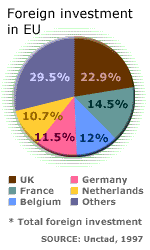
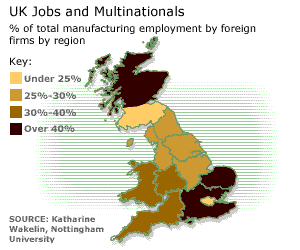
More than one-third of the UK's manufacturing sector is now foreign owned, and it is an even more important source of jobs in many regions. And the open nature of the UK's service sector, particularly in telecoms and financial services, has encouraged a recent wave of service sector investment. The UK has a total of £252.4bn ($400bn) of direct foreign investment, and attracted £52.3bn ($78bn) in 1999. Britain is also one of the biggest foreign overseas investors, with major investments in the USA, the Far East and Europe. Top in Europe The UK has more inward investment than any other EU country, at around 25% of the total, and is particularly attractive to Japanese and American firms. However, the UK's proportion has been falling recently. Within the EU, the smaller, open economies like Spain, Ireland and the Netherlands have been increasing their share of foreign investment, and even the larger sluggish ones are catching up. Britain's share of inward investment was down by 4% in 1999 to 24% percent, while all the big eurozone countries recorded an increase, according to a survey by accountants Ernst & Young. Investment in the eurozone as a whole was up 11%, while European countries outside it suffered an 18% fall. Why do foreign firms locate in the UK? Foreign firms, which decide to build a factory abroad, have to take a long-term view. It is a huge investment which cannot be reversed or made easily again. Most research shows that access to markets, the availability of a skilled workforce, good transport links and cultural amenities are all important factors. That meant that much of UK manufacturing investment is located in East Anglia and the South East, near its European markets. Regions like the North East, Scotland and Wales have been forced to spend heavily in recent years to attract high-profile Asian investment, especially in cars and electronics. However, only Wales shows an above-average proportion of foreign manufacturing employment. Northern Scotland, with its heavy foreign investment in North Sea oil, also stands out. And if services sector employment were included, the dominance of the South East and London would be even more marked. The UK has also benefited from having the most widely spoken language, and a common business culture, factors particularly important for US firms. In fact, US companies have by far the biggest share of inward investment, with nearly half the total. Invest to export Japanese companies invest a far smaller amount, about 4% of the total, but their share has been increasing fastest, with about 8% of new investment coming from Japan. They have also been most prominent in investing in the regions, where they can obtain large subsidies. However, Japanese firms have been particularly interested in using the UK as a platform to export manufacturing goods to the rest of Europe. It is no surprise, therefore, that these companies are particularly concerned about the exchange rate and have been most vocal in calling for the UK to join the euro. Their sales and profits have been dealt a blow by the high value of the pound, which has made many of their exports to Europe unprofitable. Threats to inward investment But it is less clear whether the bulk of foreign investors, particularly those who make high-tech products, or operate within the UK's service sector, are as concerned as the Japanese. Certainly any threat to leave the EU, which would limit their markets, would worry foreign firms. But the rate at which the UK goes into the euro would be just as important to them as a stable rate. And any currency mis-alignment - such as an over-valued pound - which persisted for a long time would discourage future foreign investment. A stable framework for the UK economy would probably help with this objective more than anything else. How much does the UK benefit? Another question is how much the UK actually benefit from foreign investment.
Foreign firms tend to be more productive than UK firms, using more capital equipment and more advanced technology. As a result, they are able to produce more goods for each worker and pay their workers higher. A study by Katherine Wakelin, David Greenaway and Sourafel Girma of Nottingham University concluded that foreign firms produced around 11% more on average than domestic firms, and paid their workers 6% more, even after taking into account their higher productivity. The study also suggested that, contrary to popular belief, it is US firms, rather than Japanese firms, which bring the highest productivity gains to the economy. But interestingly, the research also showed that there are relatively few "spillover" effects that spur productivity improvements in domestic firms - a potential benefit normally quoted by the government to justify its high level of grants to foreign firms. Weaker UK firms, with low levels of productivity and skills, seem to suffer most from the presence of foreign multinationals, while firms with a higher technological base seem to benefit by the increased competition. So while some workers gain higher wages, foreign investment could actually end up exacerbating the problems of weak UK domestic firms.
|