|
|




Talks offered in rail disputeSaturday, 12 January 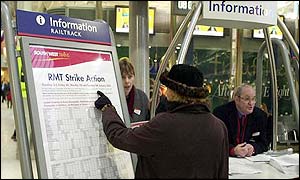
Acas hopes to avert a third strike on SWT
The conciliation service Acas has offered its services to try to end the
dispute between South West Trains and RMT union staff.
Both sides in the long-running dispute - over pay and disciplinary issues - said they have received the offer, and are considering how to respond. Acas hopes arbitration could avoid RMT's threatened third 48-hour strike on SWT - on 24 and 25 January - which it called after rejecting a 7.6% pay offer from the company.
"Where disputes have not been able to be resolved through dialogue, we would say that arbitration is one of the most important means of resolving the issues," the prime minister's official spokesman said. The second SWT strike, which ended at midnight on Tuesday, caused severe disruption on many of SWT's busy commuter lines, which serve London and the south-east. The company said it ran only about 400 of 1,700 trains on Tuesday, and even fewer on Monday. Government criticism Other action is going on in other parts of the country. A dispute in Scotland over pay has led to the cancellation of one in four services. RMT staff at Arriva Northern, hoping to narrow pay differences between guards and drivers, have announced two 48-hour strikes, on 24 and 25 January and 5 and 6 February. Trouble is also thought to be brewing over pay at Connex South Eastern and London Underground. The disruption has led to renewed criticism of the government's handling of the railways. Conservative leader Iain Duncan Smith said on Wednesday that the government's transport policy had descended into farce under the stewardship of Transport Secretary Stephen Byers. National pay bargaining Mr Blair insisted that Mr Byers was in charge of transport policy and said that much of the chaos currently experienced on the railways was as a result of the Tory privatisation of British Rail. General secretary of the train drivers' union Aslef, Mick Rix, has called for a return to national pay bargaining to end the "merry-go-round" of strikes. But George Muir, Director General of the Association of Train Operating Companies, described national pay bargaining as "out of the frying pan into the fire". "Instead of local strikes, the threat would be national strikes - as we saw in the past. "Pay differentials are simply a part of life, and national bargaining can't get rid of them."
|

|